
The question people ask about Kyoto is whether it is more crowded than it used to be. Putting the twenty-year visitor curve next to the composition of those visitors is the quickest way to see what has actually changed and what has not.
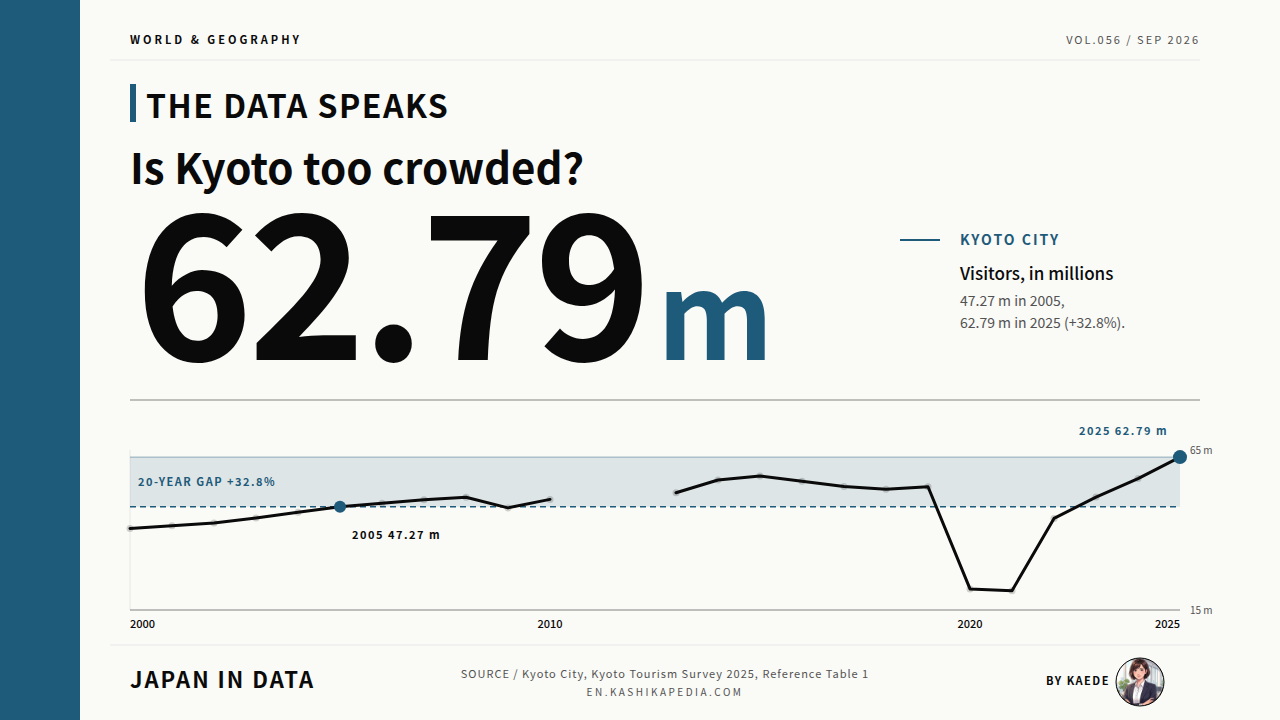
Kyoto City recorded 62.79 million visitors in 2025, the highest figure in its survey series, and 16.59 million of them stayed overnight. Twenty years earlier, in 2005, the city counted 47.27 million. The headline count grew by 32.8% over those twenty years, while overnight guests from overseas grew 11.1 times, from 0.73 million to 8.09 million.
This article reads the Kyoto Tourism Survey, the city’s own annual count, across the years 2000 to 2025. Six figures cover the long visitor curve, the split between guests resident in Japan and guests from overseas, the mix of origin countries, the month-by-month spread, and tourism spending. The 2025 edition also changed its estimation method and revised the earlier figures, which the article treats as part of the record.
How much has the number of people coming to Kyoto actually grown in 20 years?
Visitors rose 32.8%, while overnight guests from overseas rose 11.1 times.
This article was researched and edited by Kaede, Data Editor, Japan in Data. Based in Saitama, Japan. Figures are current at the time of writing. Numbers, rules and services can change, so check each official site for the latest information.
- Kyoto Passed 60 Million Visitors for the First Time in 2025
- Overnight Guests: 3.16 Million from Overseas in 2015, 8.09 Million in 2025
- Kyoto Draws a Different Mix of Countries Than Japan as a Whole
- The Crowd Is Concentrated in Time as Well as Place
- Spending Grew Three Times Faster Than Visitor Numbers
- Kaede’s Summary: Three Observations from 26 Years of Kyoto Counts
- Frequently Asked Questions
- About the Fact-Check for This Article
Kyoto Passed 60 Million Visitors for the First Time in 2025
Twenty-six years of the same count, placed side by side, show where the line moves and where it sits still. The two shaded bars are the years the article compares.
*Compiled and edited by the Japan in Data editorial team based on official government statistics.
The Kyoto Tourism Survey has published an annual visitor count since 1958, and the city website carries a continuous table from 2000 onward. In 2000 the count was 40.51 million. It crossed 50 million for the first time in 2008, at 50.21 million, and reached 56.84 million in 2015. Between 2015 and 2019 the count moved sideways, ending 2019 at 53.52 million.
The pandemic years break the series. The city did not apply the national common standard in 2020 and 2021 and published its own estimates instead, 21.59 million and 21.02 million, which the survey states cannot be compared with other years. Recovery ran through 43.61 million in 2022 and 50.28 million in 2023.
The 2024 count was 56.06 million, close to the 2015 level. The 2025 figure of 62.79 million is the first time the series has passed 60 million, and it is 11.9% above 2024. Against 2005, the starting point this article uses for its 20-year window, the increase is 32.8%. Two years, 2011 and 2012, carry no visitor estimate because the counting method was changing.
Overnight Guests: 3.16 Million from Overseas in 2015, 8.09 Million in 2025
Stacking the two groups of overnight guests in one bar makes the change in shape visible. The total barely moves after 2017, but the two halves trade places.
*Compiled and edited by the Japan in Data editorial team based on official government statistics.
Overnight guests are counted as actual persons, so a guest staying three nights counts once. In 2015 Kyoto recorded 13.62 million overnight guests, of whom 3.16 million came from overseas, a share of 23%. In 2025 the total was 16.59 million, of whom 8.09 million came from overseas, a share of 48.8%.
The other half of that arithmetic is that guests resident in Japan fell from 10.46 million in 2015 to 8.49 million in 2025. The rise in overnight guests since 2015 therefore comes entirely from overseas visitors, while the domestic figure sits below where it started. The 2025 domestic figure is also lower than 2024, when it was 9.21 million.
Guest-nights tell a related story. Kyoto recorded 29.83 million guest-nights in 2025 against 27.55 million in 2024, and overseas guest-nights alone came to 17.31 million. The average stay for an overseas guest was 2.14 nights, down from 2.31 nights in 2024.
Kyoto Draws a Different Mix of Countries Than Japan as a Whole
The same survey publishes Kyoto’s origin mix next to the national mix, so the two can be read against each other without any extra assembly on my side.
*Compiled and edited by the Japan in Data editorial team based on official government statistics.
Across Japan, Asian markets accounted for 58.9% of foreign guest-nights in 2025. In Kyoto the same figure was 42.0%. Europe and North America together took 36.3% of Kyoto’s foreign guest-nights against 21.9% nationwide, a gap of 14.4 percentage points. Oceania stood at 5.2% in Kyoto and 4.1% nationally.
*Compiled and edited by the Japan in Data editorial team based on official government statistics.
By individual origin, China led Kyoto with 3.54 million guest-nights and the United States followed with 2.74 million. Together the two accounted for 36.3% of all foreign guest-nights in the city. Italy, the United Kingdom, Spain, France and Germany each recorded between 0.48 and 0.63 million, and all five were above their 2024 figures.
Two origins in the top ten recorded fewer guest-nights than in 2024. Taiwan fell from 1.59 million to 1.26 million, and South Korea from 0.92 million to 0.84 million. Hong Kong, which appears in the national top ten, does not appear in Kyoto’s.
The Crowd Is Concentrated in Time as Well as Place
An annual total says nothing about the days people actually experience. The month-by-month line shows how the same year is distributed.
*Compiled and edited by the Japan in Data editorial team based on official government statistics.
November was the busiest month of 2025 with 5.87 million visitors, and February the quietest with 4.50 million. The survey records the gap between them as 1.3 times. Every month of 2025 was above the same month of 2024, and the largest monthly increase was in February, at 11.6%.
The 2025 survey added a new question about whether visitors had deliberately changed their behaviour to avoid crowds. 54.0% of overseas visitors and 50.9% of visitors from within Japan said they had. Among overseas visitors who had, 68.6% chose early morning or evening, 47.6% avoided the cherry blossom and autumn foliage seasons, and 36.3% went to places away from the standard sights.
The survey also records how many visitors had something they found disappointing. For overseas visitors the figure was 21.0% in 2025, against 19.4% in 2024 and 16.3% in 2023. Crowding was the most frequently written reason at 28.6% of those responses. For visitors from within Japan the figure was 47.2%, with crowding cited by 38.5%.
Spending Grew Three Times Faster Than Visitor Numbers
Money and headcount are two different curves. Putting the spending series on the same 26 years as the visitor series shows how far the two have separated.
*Compiled and edited by the Japan in Data editorial team based on official government statistics.
Tourism spending in Kyoto was 595.6 billion yen in 2005 and 2,047.4 billion yen in 2025, a factor of 3.4 against a 32.8% rise in visitor numbers over the same years. The city puts the wider economic effect at 2,219.3 billion yen and the associated employment effect at about 230,000 people.
Per-visitor spending moved in the other direction in the most recent year. The average for an overseas visitor was 67,133 yen in 2025 against 70,331 yen in 2024, a fall of 4.5%. Total overseas spending still rose because the number of overseas visitors rose faster than the per-person figure fell.
Kyoto funds its tourism survey from a lodging tax introduced in October 2018. On October 3, 2025 the city announced that a revision had been formally approved, and from March 1, 2026 the tax on a room costing 100,000 yen or more per person per night rose from 1,000 yen to 10,000 yen. The city expects lodging tax revenue of about 12.6 billion yen under the revised rates.
Kaede’s Summary: Three Observations from 26 Years of Kyoto Counts
Laying the six figures next to each other, the answer to the crowding question depends less on how many people arrive and more on which measure is being read. Three observations follow.
The question this article started from was whether Kyoto is more crowded than it used to be. The survey answers different parts of that question differently depending on whether the measure is arrivals, overnight guests, origin mix, month or money. The three observations below set out what the figures show without ranking them.
Read together, the three observations point to a single arithmetic fact: the number of people arriving in Kyoto grew by about a third over 20 years, while the number of overseas guests sleeping in the city grew elevenfold. Whether Kyoto feels more crowded depends on which of those two numbers a person is standing next to. The survey also reports that 54.0% of overseas visitors changed their plans to avoid crowds, which is itself a measure of the same conditions.
Frequently Asked Questions
Three questions come up whenever these numbers are quoted. Each one is about what the count contains rather than about how large it is.
Q1. Is Kyoto the most visited city in Japan?
The Kyoto Tourism Survey does not answer that question, and neither does any other single source. Japanese municipalities count visitors under the national common standard set by the Japan Tourism Agency in 2009, but each city applies it to its own geography. Kyoto treats the whole city area as one observation point and estimates arrivals from rail, highway bus and car traffic. Two cities using different reference points do not produce directly comparable totals.
Q2. Why do older Kyoto figures differ from what I read before?
The series has three method changes. From the 2011 survey the city moved from its own basis to the national common standard, which is why 2011 and 2012 carry no visitor estimate. From the 2019 survey overnight figures were estimated from lodging tax data instead of hotel questionnaires. From the 2025 survey the city began using Japan Tourism Agency accommodation data and revised 2019 to 2024 accordingly. The 2024 overseas overnight figure, for example, moved from 8.21 million to 7.09 million.
Q3. What is the Kyoto lodging tax and what changed in 2026?
The lodging tax is a local tax that Kyoto City has levied on hotel and inn guests since October 2018, collected by the accommodation and charged per person per night. Until February 28, 2026 the bands ran from 200 yen to 1,000 yen. From March 1, 2026 they run from 200 yen to 10,000 yen, with the top band applying to rooms at 100,000 yen or more per person per night. School trip participants and their leaders are exempt.
About the Fact-Check for This Article
Japan in Data fact-checks its articles. The evidence for this page is set out below.