
How many of the 54 reactors that ran before the 2011 earthquake are running now? The answer comes into view when the number of operating reactors and the capacity factor are laid out over time, rather than read from a single snapshot. The charts below follow the sequence one step at a time: the pre-quake peak, zero operation, and a gradual recovery.
In March 2011, when the Great East Japan Earthquake struck, Japan had 54 commercial power reactors in operation, with 3 more under construction. Nuclear power is said to have supplied about 30% of the electricity used in Japan at the time. After the Fukushima Daiichi accident, these reactors shut down one after another for scheduled inspections and other reasons. In 2012, there were periods when no reactor was operating at all. Under the new regulatory standards that took effect in 2013, a cumulative 15 reactors had restarted as of February 2026.
This article draws on primary information: the Japan Atomic Industrial Forum (JAIF) list of nuclear power reactors in Japan, and material from the Agency for Natural Resources and Energy and the Nuclear Regulation Authority. Six charts show 50 years of operating units, the capacity factor’s recovery, where the 54 pre-quake reactors stand, the 15 restarts, the 24 reactors being decommissioned, and the skew by type and region. The article does not assess the merits or safety of nuclear power; it sets out published data and regulatory facts only.
Japan’s commercial nuclear reactors are operated by electric power companies, and each reactor at a plant is counted as a separate unit. Since July 8, 2013, a reactor may restart only after the Nuclear Regulation Authority confirms that it meets the new regulatory standards. Here, a “restart” means a reactor that has resumed sending power to the grid under those standards. The capacity factor is actual generation as a share of full-output generation over the same period. The two main reactor types are pressurized water reactors (PWR) and boiling water reactors (BWR).
Of the 54 commercial reactors operating before the quake, how many are running now?
All units shut down after the accident, and for a time none were operating. 15 have restarted under the new regulatory standards (cumulative, as of February 2026), while 24 of the 54 are set for decommissioning.
Figures are current as of the time of writing. Statistics, rules and services are subject to change, so please check the official sources for the latest information.
- From 54 Before the Quake: How the Number of Operating Reactors Changed
- The Capacity Factor’s Recovery: From Zero to About 34%
- Where Are the 54 Now? Restarted, Under Review or Decommissioned
- Timeline of the 15 Restarts: From Sendai to Kashiwazaki-Kariwa
- Where the 24 Decommissioned Reactors Stand: Fukushima Daiichi and Ageing Units
- Reactor Type and Region: PWRs First, BWRs Later
- Kaede’s Summary: How Nuclear Operations Changed Across the 2011 Quake
- Frequently Asked Questions
- 🔍 About the Fact-Check for This Article
From 54 Before the Quake: How the Number of Operating Reactors Changed
Fifty years read most clearly as a single line rather than as a snapshot: the build-up, the peak, the sharp fall and the slow recovery appear side by side. The first step is to see the overall shape.
* Compiled and edited by the Japan in Data editorial team based on official government statistics.
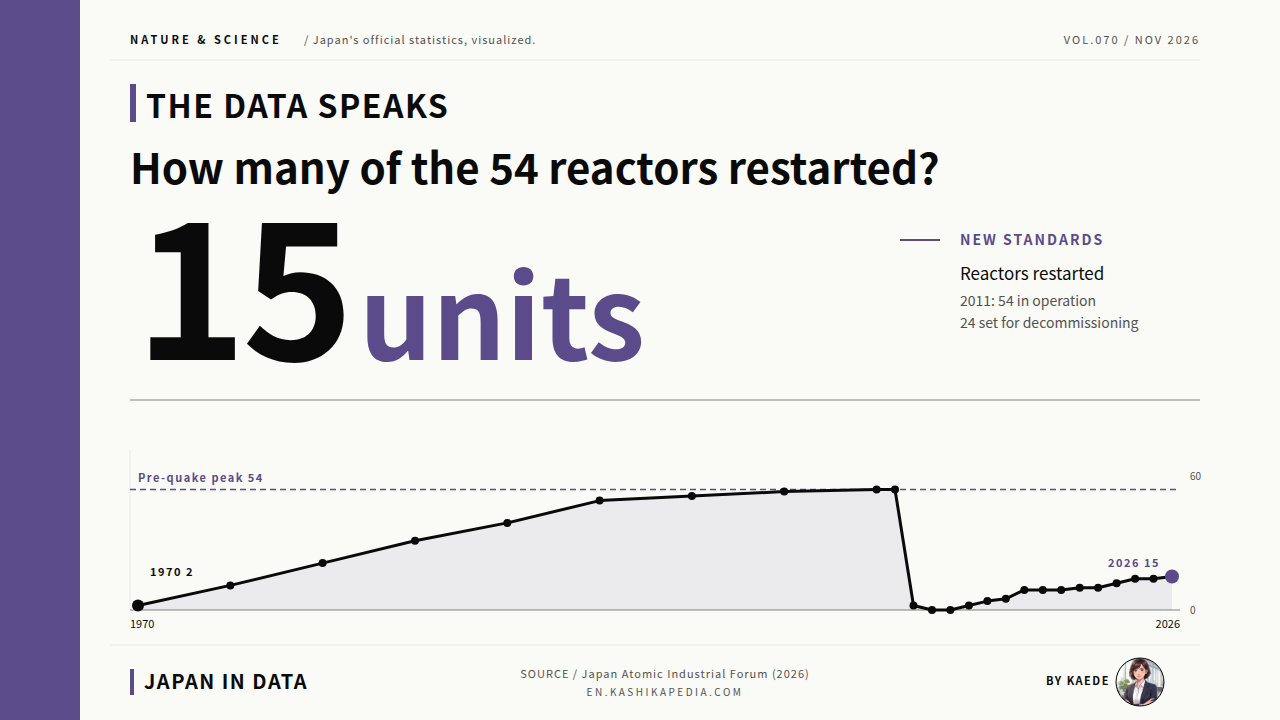
Commercial nuclear power in Japan began with the Tokai Power Station, which entered commercial operation in 1966, and the number of reactors grew from the 1970s through the 2000s. Tsuruga Unit 1 and Mihama Unit 1 started in 1970, and Fukushima Daiichi Unit 1 in 1971, with utilities adding reactors after that. According to JAIF, 54 commercial reactors were operating on March 11, 2011, plus 3 under construction. That was the highest number in operation.
After the Fukushima Daiichi accident, the operating reactors stopped one by one as they entered scheduled inspections and for other reasons. In May 2012 every commercial reactor in Japan was offline, and after temporary generation at Ohi Units 3 and 4 under a special measure (July 2012 to September 2013), the count returned to zero. Within little more than a year, the number of operating reactors had fallen from 54 to near zero.
The turning point came after the new regulatory standards took effect in July 2013. Reactors that met them were allowed to restart, beginning with Kyushu Electric Power’s Sendai Unit 1 in August 2015, and the operating count began to recover. Compared with the 54 before the quake, the pace has been gradual: as of February 2026, a cumulative 15 reactors have resumed generation under the new standards.
The line chart above shows the number of commercial reactors with an operating record in each year, excluding decommissioned units. Figures for the build-up years from the 1970s to the 2010s are approximations based on start-of-operation dates, while figures from 2011 onward are JAIF’s final values.
The Capacity Factor’s Recovery: From Zero to About 34%
How many reactors exist and how much they actually ran are separate measures. Adding the capacity factor line shows operations from a different angle than the count of units.
* Compiled and edited by the Japan in Data editorial team based on official government statistics.
The capacity factor measures how much nuclear power actually worked. It is the ratio of actual generation over a period to the output that would have been produced by running at full power throughout. Before the quake, Japan’s commercial reactors generally ran at an annual capacity factor of about 60 to 70%, alongside the effects of scheduled inspections and equipment problems.
From 2012 to 2014, with almost every reactor shut down, the annual average capacity factor fell to close to zero. Without reactors generating, Japan’s nuclear capacity remained in place as equipment but produced almost no electricity over that period.
As restarts progressed, the capacity factor rose step by step. In JAIF’s figures, the annual average was 15.5% in 2020, 28.0% in 2023, 30.6% in 2024 and 34.1% in 2025. Monthly preliminary figures for 2026 were 38.9% for January and 32.4% for February. The 2025 level of 34.1% is still about half of the roughly 70% seen before the quake, consistent with the gradual recovery in the number of operating reactors.
Where Are the 54 Now? Restarted, Under Review or Decommissioned
Breaking the 54 pre-quake reactors down in a single bar makes it easier to see where each one stands today. Restarted, under-review and decommissioned units can be compared in one view.
* Compiled and edited by the Japan in Data editorial team based on official government statistics.
Where did the 54 commercial reactors of the pre-quake era go? According to figures from the Agency for Natural Resources and Energy and JAIF (as of February 2026), all 60 commercial reactors, meaning the 54 operating at the time of the quake plus 3 under construction and those already set for closure before it, now fall into several status groups.
15 have restarted under the new regulatory standards, 3 have received approval for changes to their installation permits but have not yet operated, 8 are under review, 10 have not yet applied for review, and 24 are set for decommissioning. The 3 reactors that were under construction, Oma, Higashidori Unit 1 (TEPCO) and Shimane Unit 3, are included in the under-review and not-applied groups.
About 40% of the total, 24 reactors, are headed for decommissioning. Set against the 54 operating before the quake, the contrast between 15 restarted and 24 set for decommissioning shows how much Japan’s nuclear fleet changed across the disaster. The 15 restarts are a cumulative count of reactors that resumed generation under the new standards; this differs from the number actually generating on a given day, which changes with scheduled inspections.
Timeline of the 15 Restarts: From Sendai to Kashiwazaki-Kariwa
Listing the restarted reactors in the order they resumed generation shows when and where they came back. The timeline below follows them in sequence.
* Compiled and edited by the Japan in Data editorial team based on official government statistics.
Ordered by the date each one resumed generation (the start of power transmission), the 15 reactors restarted under the new standards trace the path of restarts over time. The first was Kyushu Electric Power’s Sendai Unit 1 in August 2015. Sendai Unit 2 followed in October that year, and in 2016 Takahama Unit 3 (Kansai Electric Power) and Ikata Unit 3 (Shikoku Electric Power) resumed generation.
In 2018, Ohi Units 3 and 4 (Kansai Electric Power) and Genkai Units 3 and 4 (Kyushu Electric Power) restarted in quick succession, with 4 reactors resuming generation in that year alone. The pace then slowed: Mihama Unit 3 followed in 2021, and Takahama Units 1 and 2 in 2023.
The pattern shifted in 2024. In November, Tohoku Electric Power’s Onagawa Unit 2 became the first reactor to restart in eastern Japan, and the first boiling water reactor (BWR), the same type as Fukushima Daiichi, to do so. Chugoku Electric Power’s Shimane Unit 2 followed in December, and in February 2026 TEPCO’s Kashiwazaki-Kariwa Unit 6 resumed generation as the 15th. About 10 years after Sendai Unit 1, restarts reached a cumulative 15.
Where the 24 Decommissioned Reactors Stand: Fukushima Daiichi and Ageing Units
The 24 reactors set for decommissioning differ in character once they are grouped by reason. The grid below counts the accident units and the ageing units separately.
* Compiled and edited by the Japan in Data editorial team based on official government statistics.
The 24 reactors set for decommissioning fall into two broad groups. One is Fukushima Daiichi Units 1 to 6, the 6 units involved in the accident. The other is 18 reactors whose closure was decided because of age, such as more than 40 years in operation, or because of the cost of safety measures weighed against their economics.
The 18 closed for age or economic reasons include Tsuruga Unit 1, Mihama Units 1 and 2, Genkai Unit 1, Shimane Unit 1, Ikata Units 1 and 2, Ohi Units 1 and 2, Onagawa Unit 1, Genkai Unit 2 and Fukushima Daini Units 1 to 4. For many of them, the operating companies decided on closure in light of the post-accident operating-period rule (40 years in principle, with one extension of up to 20 years allowed) and the cost of meeting the new standards.
A decision to decommission does not clear a site immediately. Dismantling a reactor and handling nuclear fuel and radioactive waste take a long time, and completion of decommissioning is scheduled for between the 2040s and the 2060s depending on the reactor. For the 6 Fukushima Daiichi units, the plan is to complete decommissioning about 30 to 40 years after cold shutdown.
Reactor Type and Region: PWRs First, BWRs Later
Restarts are uneven by geography and reactor type. Two bars, one for type and one for region, compare where the restarted reactors came from.
* Compiled and edited by the Japan in Data editorial team based on official government statistics.
Splitting the 15 restarted reactors by type and region shows a clear skew. Japan’s commercial reactors are mainly of two types, pressurized water reactors (PWR) and boiling water reactors (BWR), and Fukushima Daiichi used boiling water reactors. The chart above divides the 15 restarts along both of these lines.
Of the 15 restarted reactors, 12 are pressurized water reactors, all located in western Japan. By region, 13 are in western Japan and 2 in eastern Japan. Restarts proceeded from PWRs in the west, beginning with Kyushu Electric Power’s Sendai (2015), followed by Kansai Electric Power’s Takahama, Ohi and Mihama, Shikoku Electric Power’s Ikata, and Kyushu Electric Power’s Genkai.
Restarts of boiling water reactors like Fukushima Daiichi, and of reactors in eastern Japan, came later. The first restart in eastern Japan was Tohoku Electric Power’s Onagawa Unit 2 in 2024, which was also the first BWR restart. A restart requires both conformity with the new standards and the consent of the host municipality, and some observers link the skew by type and region to these procedural requirements. This article takes no position on nuclear power or its safety; the differences in restart order by region and type are what the data shows.
Kaede’s Summary: How Nuclear Operations Changed Across the 2011 Quake
With the six charts side by side, the way reactor operations moved across the earthquake appears as a shape over time. The box below sets it out as three observed facts.
To the question of how many of the 54 pre-quake reactors are running now, the charts in this article show that both the number of operating reactors and the capacity factor fell sharply and then recovered gradually. Because the picture changes with the counting method and the point in time chosen, this section does not argue for or against nuclear power; it sets out what can be observed in the data.
Read together, the three observations organize nuclear operations across the quake into three overlapping movements: a fall from a peak of 54 to zero followed by a gradual recovery to 15, a split into restarted, under-review and decommissioned reactors, and a skew by reactor type and region. The answer to how many are running now depends on which point in time, and which counting method, is used. That observation itself describes where nuclear power in Japan stands after the disaster.
Frequently Asked Questions
Reactor operating figures depend on three things read together: the point in time, the counting method, and whether a figure counts reactors generating now or a cumulative total. The same number can carry a different meaning depending on these three points.
Q1. How many nuclear reactors did Japan have before the Great East Japan Earthquake?
When the earthquake struck on March 11, 2011, 54 commercial power reactors were in operation and 3 more were under construction (Japan Atomic Industrial Forum). Nuclear power is said to have supplied around 30% of the electricity used in Japan at the time. After the accident, these reactors shut down in turn for scheduled inspections and other reasons, and in 2012 there were periods when none were operating.
Q2. How many nuclear reactors have restarted?
As of February 2026, a cumulative 15 reactors have resumed generation after meeting the new regulatory standards introduced in 2013 (TEPCO’s Kashiwazaki-Kariwa Unit 6 was the 15th). The number actually generating on any given day varies with scheduled inspections. Of the 54 pre-quake reactors, 24 are set for decommissioning, while 8 are under review and 10 have not applied for review (Agency for Natural Resources and Energy, Japan Atomic Industrial Forum).
Q3. Where are the restarted reactors located?
Restarts were initially concentrated at plants in western Japan using pressurized water reactors (PWR), beginning with Kyushu Electric Power’s Sendai (2015) and followed by Kansai Electric Power’s Takahama, Ohi and Mihama, Shikoku Electric Power’s Ikata and Kyushu Electric Power’s Genkai. Restarts of boiling water reactors (BWR) like Fukushima Daiichi, and in eastern Japan, came later; the first in eastern Japan was Tohoku Electric Power’s Onagawa Unit 2 in 2024. A restart also requires the consent of the host municipality.
🔍 About the Fact-Check for This Article
Japan in Data fact-checks its articles. The evidence behind the fact-check for this page is listed below.