
The inbound and outbound student figures come from two separate surveys, and they count in different ways. Rather than forcing them onto one scale, setting the 42-year series and the 20-year series side by side makes their uneven movement easy to see.
International students in Japan numbered 408,069 as of May 1, 2025, up 71,361 (21.2%) on the previous year and the highest figure on record. Japanese students who began study abroad numbered 91,054 in FY2024 (April 2024 to March 2025), up 1,875 (2.1%), but still below the record 115,146 set in FY2018. Inbound numbers keep setting records while outbound numbers recover without reaching their peak, and that asymmetry is the current shape of the data.
This article works from primary sources: two surveys by the Japan Student Services Organization (JASSO) and materials published by the Ministry of Education, Culture, Sports, Science and Technology (MEXT). It charts 42 years of inbound and 20 years of outbound figures, the breakdown by level of study and country of origin, and the length of stays abroad. The two surveys count differently, so the definitions are noted along the way.
Japan’s student mobility figures come from two separate surveys by JASSO, an agency under the Ministry of Education, Culture, Sports, Science and Technology. The inbound survey counts international students enrolled on May 1 each year, a stock figure. The outbound survey counts Japanese students who began study abroad during a fiscal year, a flow figure, as identified by Japanese universities and colleges. Japan’s fiscal year runs from April to March. Japanese language institutes are schools that teach Japanese to foreign learners.
How are student numbers in and out of Japan moving?
Inbound hit a record 408,069. Outbound is about 79% of its peak.
Figures are current as of the time of writing. Statistics, rules and services are subject to change, so please check the official sources for the latest information.
- International Students in Japan Over 42 Years: From About 10,000 to Over 400,000
- Inside the Increase: Changes by Level of Study and Country of Origin
- Japanese Students Abroad Over 20 Years: The FY2018 Peak and the FY2020 Low
- What Outbound Study Looks Like: Two in Three Stay Under One Month
- Inbound and Outbound Side by Side: Stock Versus Flow
- Kaede’s Summary: The Asymmetry Shown by Two Surveys
- Frequently Asked Questions
- 🔍 About the Fact-Check for This Article
International Students in Japan Over 42 Years: From About 10,000 to Over 400,000
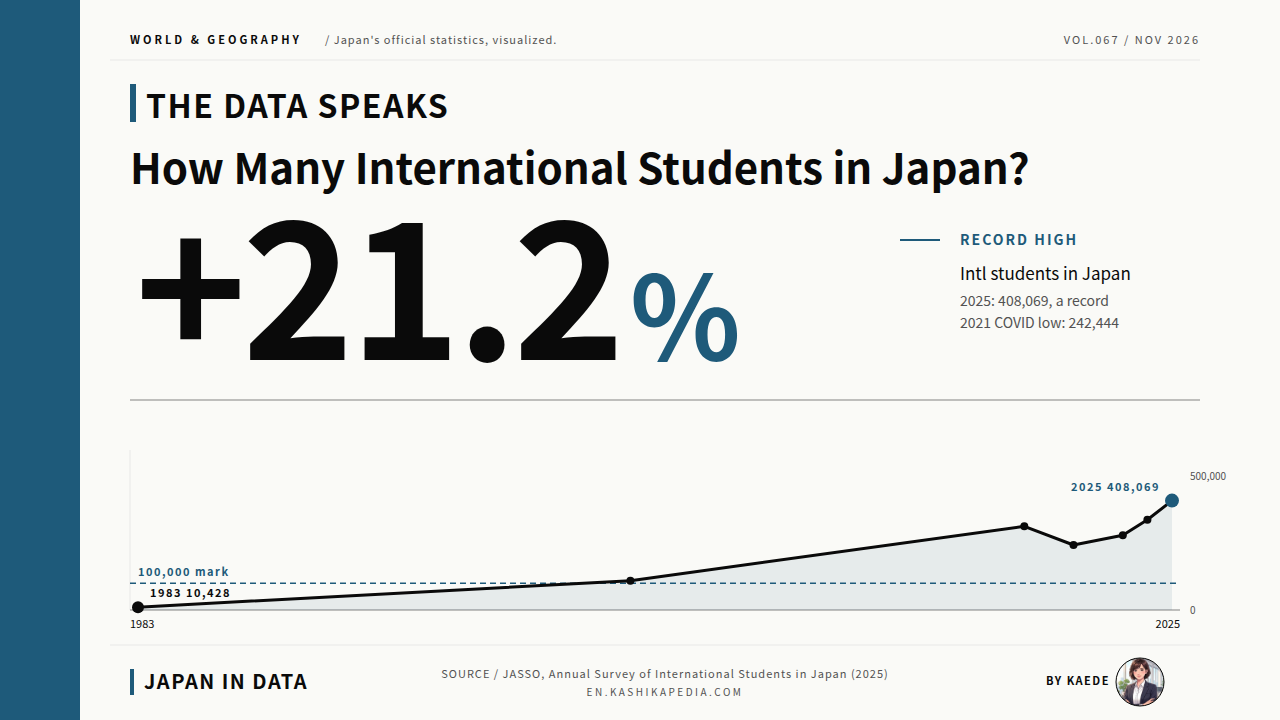
Forty-two years of annual data, drawn as a single line, show where the rises and dips fall at a glance. The part worth watching is the angle of the last four years, climbing steadily from the 2021 low to the latest figure.
* Compiled and edited by the Japan in Data editorial team based on official government statistics.
According to JASSO, the number of international students rose from 10,428 in 1983 and first passed 100,000 in 2003, at 109,508. Growth continued to 312,214 in 2019. In 2020 and 2021, while COVID-19 entry restrictions remained in place, the total fell for two consecutive years, reaching 242,444 in 2021.
The turn came from 2022 onward. The total reached 279,274 in 2023 (up 20.8%), 336,708 in 2024 (up 20.6%) and 408,069 in 2025 (up 21.2%), three consecutive years of growth above 20%. In 2025 the total stood about 1.7 times its 2021 low and passed 400,000 for the first time.
The series includes a change in coverage. Students at Japanese language institutes were added to the survey from FY2011, when the “College Student” and “Pre-college Student” residence statuses were merged, and totals since then include them. When reading the long-run trend from 1983, the wider coverage from around 2011 needs to be kept in mind.
Inside the Increase: Changes by Level of Study and Country of Origin
Setting seven levels of study as paired bars for two years shows where the growth occurred through the difference in length. The gains in the top two rows account for almost all of the overall increase on their own.
* Compiled and edited by the Japan in Data editorial team based on official government statistics.
By level of study, the largest group in 2025 was Japanese language institutes at 140,174 (up 30.7%), followed by vocational schools (specialized courses) at 106,829 (up 39.8%). Together these two groups added 63,360 students. Japanese language institutes and vocational schools account for about 89% of the total increase of 71,361 (editors’ calculation). Universities (undergraduate) had 92,442 and graduate schools 60,013, also record levels, but their growth rates stayed in single digits.
By Country and Region of Origin: Nepal Passes 100,000
* Compiled and edited by the Japan in Data editorial team based on official government statistics.
The top countries and regions of origin were China at 131,097, Nepal at 100,239, Vietnam at 43,366, Myanmar at 29,413 and Sri Lanka at 17,626. Nepal rose from 64,816 a year earlier, about 1.5 times in one year, and passed 100,000 for the first time. With Myanmar up 77.2% and Sri Lanka up 43.7%, intake from South and Southeast Asia grew sharply.
A note on the data: in the HTML tables on JASSO’s data page, some change-rate columns appear to be calculated on a basis other than year-on-year change. The rates in this article were recalculated by the editors as year-on-year changes from the published counts, and they match the figures released by MEXT.
Japanese Students Abroad Over 20 Years: The FY2018 Peak and the FY2020 Low
The outbound line is marked by an almost vertical drop in FY2020. Compare the depth of that drop, and the height of the recovery that followed, with the FY2018 peak just two years before it.
* Compiled and edited by the Japan in Data editorial team based on official government statistics.
The number of Japanese students abroad rose from 18,570 in FY2004, the start of the series, to a record 115,146 in FY2018. In FY2020, the first year of the COVID-19 pandemic, it fell to 1,487 from 107,346 the year before. The survey counts people who began study abroad during each year, a flow measure, so the halt in travel appears in the series as a deep trough.
A recovery followed: 10,999 in FY2021, 58,162 in FY2022, 89,179 in FY2023 and 91,054 in FY2024. The latest increase, however, was smaller, at 1,875 (2.1%). The FY2024 level remains about 79% of the FY2018 record. JASSO’s press release also states that the figure has not reached the FY2018 level.
In this survey, the number of Japanese students studying abroad is the number of people who began study at overseas universities and similar institutions during the year, as identified by Japanese universities and colleges, whether or not under an exchange agreement. Study outside agreements has been included since FY2009. In FY2024, 57,262 studied under agreements and 33,792 outside them.
What Outbound Study Looks Like: Two in Three Stay Under One Month
In the bars by length of stay, only the top row stands far out from the rest. The recovery in the total and the mix of durations are moving separately, and the chart keeps the two apart.
* Compiled and edited by the Japan in Data editorial team based on official government statistics.
By length of stay in FY2024, programs of less than one month accounted for 60,301 students, or 66.2% of the total (editors’ calculation). This was also the only category to grow, up 5.7% on FY2023. Every category of one month or longer fell from the previous year. Within the recovering total, the growth is concentrated in short programs.
The top destinations were the United States at 12,627 (down 6.6%), Australia at 9,329 (up 1.8%) and South Korea at 8,360 (down 0.3%). By region, Asia was the largest at 36,904 (up 7.0%), while North America stood at 19,363 (down 8.4%). In destinations too, nearby Asia is growing and North America is shrinking.
Inbound and Outbound Side by Side: Stock Versus Flow
When two figures share one chart, the difference in how they are counted belongs inside the chart. The pairing is not a contest of size; it is a way to observe the two numbers together with their different definitions.
* Compiled and edited by the Japan in Data editorial team based on official government statistics.
The 408,069 international students are an enrollment count on May 1 (a stock), while the 91,054 Japanese students are those who began study abroad during the year (a flow). The two come from different surveys with different definitions. They cannot be compared directly, but as a rough guide to scale, the gap is about 4.5 times (editors’ calculation).
A reference series of Japanese students abroad, counted by overseas bodies such as UNESCO and the US Institute of International Education (2023 data, compiled by MEXT), gives 50,139. This series also uses a different definition, so it cannot simply be joined to either of the two series shown in the chart above.
Put in simple terms, inbound numbers grew about 39 times over 42 years (our calculation: 408,069 ÷ 10,428 ≈ 39.1). On the outbound side, two in three stayed less than one month (our calculation: 60,301 ÷ 91,054 ≈ 66.2%). Inbound numbers that keep growing in scale and outbound numbers that recover while getting shorter both appear in the same May 2026 releases.
Kaede’s Summary: The Asymmetry Shown by Two Surveys
Laying out all of the charts so far confirms that inbound and outbound numbers move to separate rhythms. Here they are, organized as three observations drawn only from the figures already shown above.
The claim that young Japanese people have become inward-looking is often made alongside the outbound figures. This article takes no position on whether the claim holds, but the charts that set the two surveys side by side offer some material for examining it. The differences in how the data look are set out below as observations.
Taken together, the three observations show that neither side fits a single phrase such as “more international students” or “a retreat from study abroad.” Inbound numbers are changing in both scale and composition, while outbound numbers are recovering in total and shortening in duration at the same time. Each figure here is read together with its survey, its definition and its period.
Frequently Asked Questions
When reading a chart of student numbers, check three things together: what the survey covers, how it counts and what period it uses. The same phrase, “number of students,” becomes a different statistic when any of the three changes.
Q1. Can the Numbers of International Students and Japanese Students Abroad Be Compared Directly?
Not directly. The number of international students is the count enrolled on May 1 each year (a stock), while the number of Japanese students abroad is the count who began study during the fiscal year (a flow), and the surveys and definitions differ. The comparison chart in this article is only a guide to scale. The overseas-based count (50,139 in 2023 data) uses yet another definition, and these series cannot be joined together.
Q2. Can the Data Confirm That Young Japanese Have Become Inward-Looking?
There is no single answer. Looking only at totals, the FY2024 figure of 91,054 is about 79% of the FY2018 peak, which can be read as a recovery still under way. At the same time, stays of less than one month make up 66.2%, and every category of one month or longer has fallen. The conclusion depends on which measure is taken as the yardstick, so this article sets out the facts without a verdict.
Q3. From Which Year Can Long-Run Charts of Student Numbers Be Compared?
There are three breaks. For international students, Japanese language institutes were added from FY2011, and totals since then include them. For Japanese students abroad, study outside agreements has been counted since FY2009, and colleges of technology and vocational schools (specialized courses) since the FY2013 survey. The overseas-based series changed its definition in the 2013 data and dropped OECD sources from the 2023 data. Comparisons within ranges that do not cross these points avoid the breaks.
🔍 About the Fact-Check for This Article
Japan in Data fact-checks its articles. The evidence for the fact-check on this page is set out below.